In today’s competitive UK retail and warehousing landscape, speed, accuracy, and operational efficiency are no longer optional — they’re essential. Whether you run a high-street store, a supermarket chain, or a distribution centre, every second saved at the checkout or during stock handling directly impacts customer satisfaction and profitability.
This is where barcode scanners play a critical role. Often overlooked, these devices form the backbone of modern retail and warehouse operations, helping businesses process sales faster, maintain accurate inventory records, and streamline daily workflows.
Let’s explore what a barcode scanner is, how it works, and why it’s a smart investment for UK B2B businesses.
What Is a Barcode Scanner?
A barcode scanner is an electronic device that reads and decodes information stored in barcodes — the familiar black-and-white lines or square QR-style codes printed on products, cartons, and pallets.
Each barcode contains a unique product identifier linked to your business system. When scanned, it instantly retrieves vital information such as:
-
Product name
-
Price
-
SKU number
-
Stock availability
Instead of manually entering data, staff simply scan the code, and the system captures the information automatically. This significantly reduces human error and speeds up transactions.
Across the UK, barcode scanners are widely used in:
-
Retail stores and supermarkets
-
Warehouses and distribution centres
-
Logistics and courier services
-
Manufacturing units
-
Healthcare facilities
For B2B organisations, they are essential tools for tracking inventory, managing orders, and maintaining operational accuracy.
How Does a Barcode Scanner Work?
Although it may seem technical, the scanning process is straightforward:
1. Scanning the Code
The scanner emits a laser beam or captures a digital image of the barcode.
2. Reading the Reflection
The sensor detects the reflected light pattern (for laser scanners) or analyses the captured image (for imaging scanners).
3. Decoding the Information
Built-in software translates the barcode pattern into digital data.
4. Sending Data to Your System
The decoded information is instantly transferred to your POS or warehouse management system, displaying product details on screen.
Think of a barcode scanner as a digital translator — converting printed codes into usable business data within seconds.
Types of Barcode Scanners Used in UK Retail & Warehousing
Different businesses require different scanning solutions. Here are the most popular types used across the UK:
1. Handheld Barcode Scanners
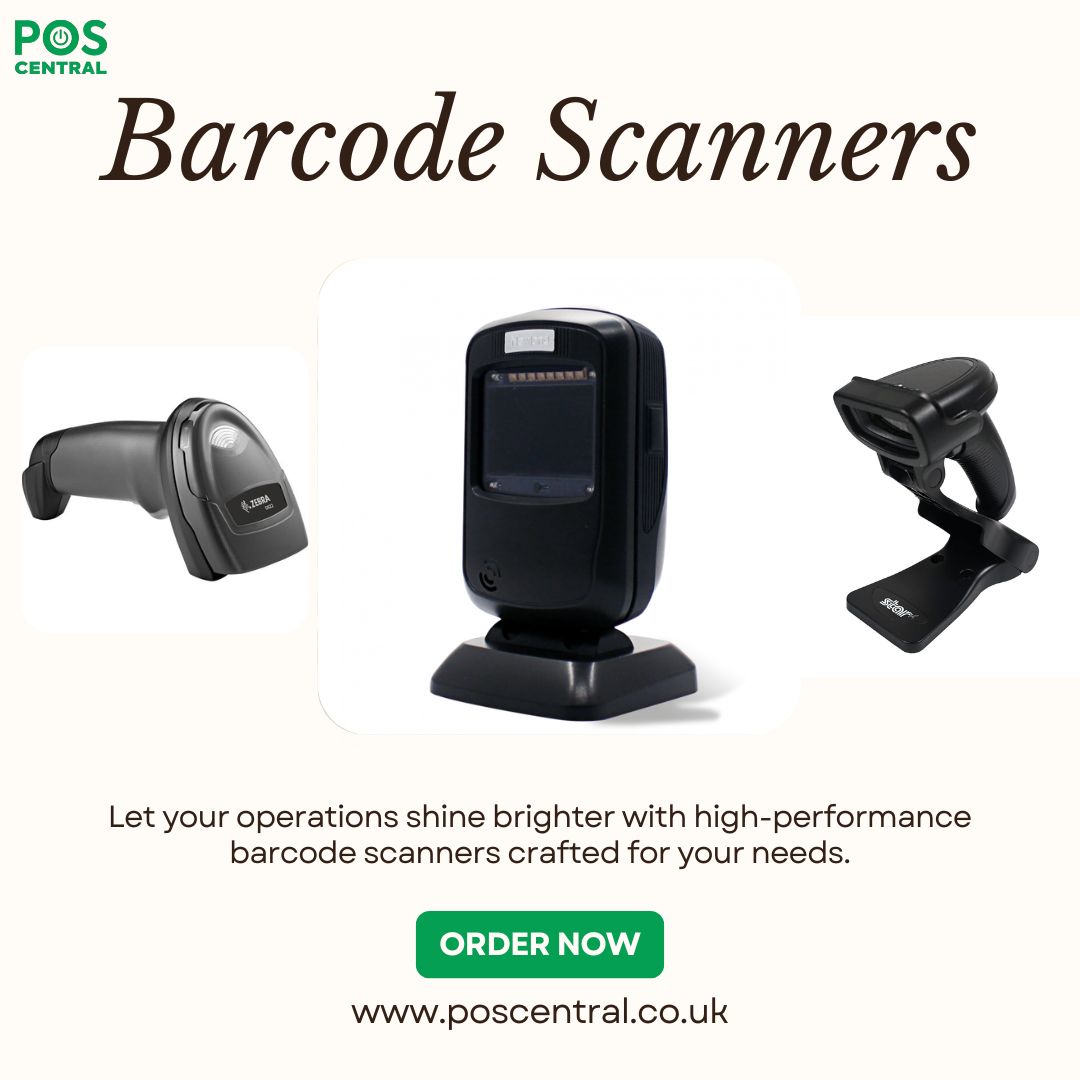
Compact, reliable, and easy to use, handheld scanners are common at retail tills. They connect via USB and suit small to medium-sized businesses.
2. Wireless Barcode Scanners
Using Bluetooth or Wi-Fi, these scanners allow staff to move freely across shop floors or warehouse aisles. Ideal for stock checks and large premises.
3. Presentation Scanners
Fixed on counters, these automatically scan barcodes when items pass in front of them. Widely used in supermarkets, pharmacies, and convenience stores.
4. 2D Barcode Scanners
Capable of reading both traditional barcodes and QR codes, these are perfect for digital vouchers, mobile payments, and logistics tracking.
Leading brands such as Zebra, Honeywell, and Datalogic supply robust scanners designed for heavy commercial use, making them ideal for UK B2B environments.
Key Benefits for UK Businesses
Barcode scanners offer far more than faster checkouts. They improve overall business performance:
-
Faster Transactions – Reduces queues and waiting times
-
Higher Accuracy – Eliminates pricing and data-entry mistakes
-
Real-Time Stock Updates – Improves inventory visibility
-
Improved Customer Experience – Faster service builds loyalty
-
Seamless POS Integration – Works smoothly with modern systems
-
Better Business Insights – Accurate data supports smarter decisions
For warehouses, scanners also improve:
-
Order picking accuracy
-
Goods-in processing
-
Stock audits
-
Shipment verification
How to Choose the Right Barcode Scanner
Before investing, consider your operational needs:
-
Scanning Distance – Short-range for tills, long-range for warehouses
-
Connectivity – USB, Bluetooth, or Wi-Fi
-
Compatibility – Works with your POS or ERP system
-
Ergonomics – Comfortable for long shifts
-
Durability – Shock-resistant for busy environments
-
Support & Warranty – Choose trusted UK suppliers
The right device ensures long-term efficiency and lower maintenance costs.
Common Myths About Barcode Scanners
“They’re only for large retailers.”
Small and medium businesses benefit just as much from speed and accuracy.
“Wireless scanners are complicated.”
Most modern models are plug-and-play and easy to set up.
“They’re too expensive.”
There are affordable options for every budget, from entry-level to industrial-grade models.
The Future of Barcode Scanning in the UK
Barcode technology continues to evolve with:
-
AI-driven stock forecasting
-
Cloud-based inventory systems
-
Omnichannel retail integration
-
Contactless scanning solutions
-
Smart warehouse automation
As UK businesses embrace digital transformation, barcode scanners will remain central to efficient operations.
Conclusion
Barcode scanners have become indispensable tools for UK retail and warehousing businesses. They enhance accuracy, reduce processing time, improve stock control, and elevate customer experience.
Whether you manage a retail chain or a distribution hub, investing in the right scanning technology will drive productivity and long-term growth.
If you’re looking for reliable, business-grade barcode scanners, explore the professional range available at POS Central UK — your trusted partner for retail and warehouse technology solutions.
Read more:
| Cash Drawer Solutions for POS Cash Register Systems in Retail |

At POS Central UK, we power smarter and faster business operations with cutting-edge point-of-sale solutions. From barcode scanners and receipt printers to label printers and cash drawers, we deliver trusted POS hardware from global brands. Our commitment lies in offering high-performance, durable, and compatible products tailored for retail, hospitality, and warehouse setups. With fast UK-wide delivery, expert support, and competitive pricing, POS Central UK is your reliable partner for seamless POS technology and business growth.